

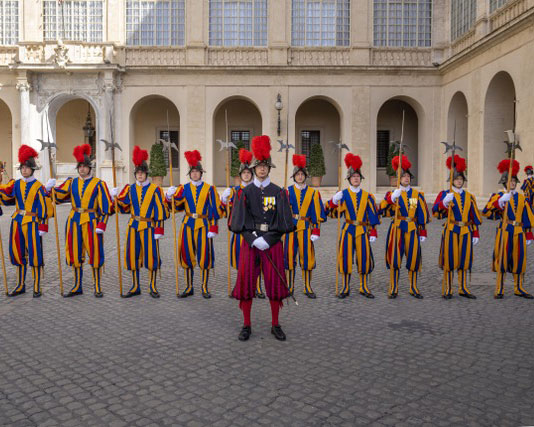
What saint is associated with a sword and rosary? Most hagiographers would likely name as their first choice Saint Ignatius of Loyola, the sixteenth-century nobleman who, after being a soldier for Spain became as ‘soldier for Christ’ and founded the Society of Jesus (Jesuits) in 1534. St. Ignatius had a profound devotion to the Rosary. Those who grow up in Switzerland might suggest another candidate: St. Nicholas de Flue, honored by Protestants and venerated by Catholics as the Patron Saint of that country. A fifteenth-century soldier turned hermit, he too is remembered for his military prowess and his reverence for the Blessed Mother.
Perhaps today the closest living paragons for this distinction would be the members of the Guardia Svizzera Pontificia, generally known as the Swiss Guard. Indeed, the patron saint of the Swiss Guard is in fact St. Nicholas of Flue.
NCCF is proud to report that the Swiss Guard is one of the organizations it supports. The Guard has played a long and important history in the life of the Church. Readers who are interested should visit its website for further information.
Suffice it to mention here that the Guard is the world’s oldest standing army. Founded in 1506 by Pope Julius II it has, with a few interruptions, existed since then. Beyond its ceremonial role as Guard of Honor, the Guard protects the Holy Father and provides protective security within the territory of Vatican City. Numbering 135 members, it has strict requirements for admission. Primarily, candidates seeking membership must swear to serve and protect the Pope faithfully, loyally, and honorably, even at the cost of their own lives. Service is a vocation. They must be unmarried Swiss males between the ages of 19 and 30 who have some training in the Swiss military. Their height must be over 5 ft and 8.5 inches. Members of the Guard are permitted to marry after five years of service and all members reside in quarters in the Vatican.
Their colorful attire was redesigned one hundred years ago both to capture and retain its Renaissance aspect and to meet practical demands. While the Guard is equipped to use firearms, it should be noted that Vatican City does employ its own Gendarmerie for police protection of the community.
As its history shows, the Guard has experienced violence. During the sack of Rome in 1527, all but 42 of the then 189 members of the Guard lost their lives in defense of Pope Clement VII and his papacy. More recently, some of us may remember the attempt on the life of Pope John Paul II in 1981 and the reaction of the Guard members at the time. It should also be noted that when the Holy Father travels outside the Vatican members of the Guard accompany him in plain clothes.
It is, of course, a great honor for a young man to be accepted and to serve in this elite group who are selected to protect the Vicar of Christ. One is reminded of the account In Matthew’s Gospel. At the time of his arrest, Jesus reprimands his would-be protectors by telling them that if he so chose, he could call on twelve legions of angels to come to his rescue. These Rosary toting Helvetian warriors have large shoes to fill as they participate in the advance of the Kingdom.